Contributed By : Shivang Prabhakar
Thursday, March 27, 2008
The first women only hotel opens in Riyadh
Contributed By : Shivang Prabhakar
Posted by PropertyMixer Admin at 2:17 PM 0 comments
Labels: hotel for women, luthan hotel, riyadh, Saudi
Sunday, March 16, 2008
IT & Tourism both pushing Kochi to top of prospective investment destinations

IT & Tourism both pushing Kochi to top of prospective investment destinations
The important thing to remember is that Kochi is the one city which is well connected to the rest of the world through sea. This is also one of the reasons for Kochi being identified as an attractive destination for investments. Moreover, this inflow of investments has created realty prospects in the city, both residential and commercial as the IT firms are bringing in more and more people into the city. And with the coming up of Cochin Special Economic Zone (CSEZ) the economical capital of Kerala is now even more attractive to the investor counting on economic and realty prospects.
With this year’s budget not renewing the STPI screme for IT companies, the only resort for IT companies to still enjoy a tax holiday will be to move into SEZs and Kochi well qualifies all criterions of an ideal investment where the real estate owned by these companies will also give them considerable returns.
The thrust from NRI remittances and the tourism sector are also greatly responsible for the changing postcard picture of Kochi. Restricted by the sea on its western coast, Kochi is spilling over to the neighbouring towns and villages, where land prices have made impressive gains. Once considered distant, neighbourhoods like Edappally and Tripunithura have appreciated from Rs.25, 000 to Rs.2 lakh for a cent.
The growing demand for housing units and the constraints on space have induced city builders to focus on building apartments in Kochi. Local builders are offering top-of-the line fittings and lifestyle add-ons like clubs and swimming pools to apartment complexes to woo home makers who prefer these homes for the security and convenience they offer.
With everything from nice sceneries to good infrastructure and connectivity Kochi sounds like the place to invest and many of the “Returning NRIs” to India have sought after this opportunity and already invested their monies in this amazing and very cosmopolitan city.
Contributed By : Shivang Prabhakar
Posted by PropertyMixer Admin at 10:34 AM 1 comments
Labels: Cochin, Kochi, Kochi investment in property, Kochi real estate, nri destination, SEZs in Kochi
Thursday, March 13, 2008
Future Group's 'Pantaloon Retail' to sell "walk-in apartments" in India
The Kishore Biyani-led Future Group, whose flagship company Pantaloon Retail operates over 1,000 stores nationwide, is entering into a joint venture with Mr Sumit Dabriwala, a Kolkata-based developer - is looking to market its 2 & 3 bed-room "walk-in" apartments through Future Group stores such as Big Bazaar.
This initiative is a part of the Future Group’s diversification strategy where they are foraying into selling real estate and health care, so as to leverage their physical presence across the country. The apartments is an ‘all-fitted ready-to-live-in apartments’ and a new brand is also being worked upon by the company to mark its foray into this industry.
Home Solutions Retail will provide the brown and white goods required to furnish these apartments. FH Residences is also looking to advertise its apartments in Future Group malls.
Posted by PropertyMixer Admin at 2:53 PM 0 comments
Labels: Future Group, Future Group to sell real estate, Pantaloon Retail
Wednesday, March 12, 2008
Feng Shui & the BA GUA octagon
The BA GUA octagon is one of the tools used in Feng Shui to help determine preferred locations for certain functions in the home or office. The BA GUA is placed with the front door of the floor plan of your home or office placed at the bottom of the BA GUA octagon.The bagua divides any space into nine areas. Each area corresponds to a different aspect of your life. Whatever is going on energetically (good or bad) in that part of your space will affect the related aspect of your life (see diagram).
Align the bottom edge of the bagua with the wall the door is in. Stretch the bagua sideways or lengthwise to cover the entire space. The door or entryway will always be in ken, kan, or chien gua, although it may overlap more than one gua. As you stand in the doorway facing into the space, hsun gua is always at the far left; kun gua is always to the far right, and li gua is always at the center of the wall opposite you.
If there is more than one way to enter a space, orient the bagua to the main door or entryway. Even if you usually enter your home through the garage, align the bagua of your home to the front door.
Every space has a bagua. There is a bagua for your plot of land, a bagua for your house, and a bagua for each room within your home. You can even apply the bagua to your desk, bed, or stove.
The bagua is rich with meanings and associations. The most important meanings of each gua are shown below....

(1.) Prosperity and Abundance: This is the area that relates to wealth or having money for the good things in life. It does not have to do with life's necessities such as food, rent, and utility bills. Many Feng Shui consultants consider this area to be a power source since money is often viewed as power. If you are seeking big money then this is the corner that you must work upon. Prosperity and Abundance's colors are purple, green, gold, and red. Its body part is the hip and its associated number is 8.
(2.) Fame and Reputation: This is the area of the home that supports you as a person out in the real world. It deals with how others perceive you which in turn makes a great difference in the area of money and relationships. It also has a lot to do with your own integrity and honest which in turn will make a difference in your dating life as well as in your other relationships. For this reason, even if you are a jerk, or if people just think that you are a jerk, then you still do not have to despair since the fame and reputation area can help you out. This area's element is fire and its color is red. Its shape is triangular; its creative cycle items are wood, green, and columnar; its destructive cycle items are water, black, and undulating; its body part is the eye; and it's associated with the number 1.
(3.) Relationships and Love: If you are seeking a relationship, or simply looking to have a really good time then look no further than this area of the bagua! It is very important that this area of your home be balanced in order that you can have harmony in your relationships. So, before deciding to become a monk or a nun, you should make sure that this area of your hope is balanced. Relationships and Love's colors are pink, red, and white. It is associated with all major body organs and the number 2.
(4.) Creativity and Children: This area of your home relates to creative thinking. You may wish to begin in this area since it will help you form creative cures for the rest of your home. This area also relates to children since they are well known for their creative thinking abilities. Anything to do with working with children (whether they are yours or not, your siblings, or even the children that you may have in the future) should be done in this area of your home. Creativity and Children's element is metal; its color is white; and its shape is round or mounded. Its creative cycle items include Earth, yellow, flat or square shapes; its destructive elements include fire, red, and pointed shapes. It is associated with the mouth and the number 3.
(5.) Helpful People and Travel: This area of your home is set aside for calling upon someone who can make your life easier, whether it is a teacher, inspirational writer, maid, or other person who is helpful. Helpful People and Travel's color is grey, black, and white. It is associated with the head and the number 5.
(6.) Career and Life Path: This area of your home is linked to whatever it is that you are supposed to be doing in life, whether it is business or traversing a more spiritual path. This area of your home is dedicated to getting you onto the right path for your life. Career and Life Path's element is water; its color is black; its shape is undulating and free forms. Its creative cycle elements include metal, white and round objects while its destructive cycle elements include earth, yellow, and flat or square objects. It is associated with the ear and the number 6.
(7.) Skills and Knowledge: This area of your home effects how you learn, store and use knowledge. While each gua's energy affects the areas around it, this one is especially worthy of your attention. For instance, if you do not have the ability to manage the money you earn then it may erroneously appear that your Prosperity section is not working for you. This area is especially worthy of attention if you are in school but simply cannot bring yourself to study. Skills and Knowledge's colors are blue, black, and green. It is associated with the hand and the number 7.
(8.) Family: This area is associated with family issues. It also holds the energy for every day monetary issues such as rent, food, and the other necessities of life. Thus, if you do not have this area in order then your Prosperity area may never really reach its true potential. Family's element is wood; its color is green; and its shapes are rectangular, columnar, and vertical. Its creative cycle items include water, black, and undulating shapes while its destructive cycle elements include metal, white, and round objects. It is associated with the foot and the number 4.
(9.) Health and Other: The center of the bagua contains all of the other life situations which are not mentioned above. Since this area is located in the middle of your home it geographically touches all other areas and thus, due to its location it affects all other areas, both literally and figuratively. As the old saying goes, "If you don't have your health, you don't have anything." Health's element is Earth; its colors are yellow and earth tones; its shape is square, horizontal, and flat. The creative cycle elements include fire, red, and pointed objects while the destructive cycle items include wood, green, and columnar objects. It is associated with any of the body parts that are not associated above and the number 9.
Posted by PropertyMixer Admin at 11:03 PM 0 comments
Labels: ba gua, elements of feng shui, Feng shui, feng shui octagon
Commercial Space - is india priced out ?
Indian office space has witnessed one of the fastest appreciations in rentals, in the world, the latest survey by global consultancy firm Cushman & Wakefield reveals. Consultants and experts feel that this is a matter of concern as it clearly suggests that supply of office space is not keeping pace with the demand.
Office space in Nariman Point, the central business district of Mumbai, and Connaught Place in Delhi, rank fifth and 10th among the costliest commercial sites of the world. Both of them have moved up by two ranks, since last year. The occupancy cost, including all the maintenance expenditure, for Nariman Point, is Rs 546 per sq ft per month, and for Connaught Place it is Rs 423 per sq ft per month. These rates have nudged Nariman Point and Connaught Place past the costliest areas in New York, Washington, Shanghai and Zurich.
MD of CB Richard Ellis (South Asia), Anshuman Magazine, says if the trend continues for some more time, India will loose the advantage of being a cheap destination for companies to shift base from other countries. The fact that cities like Delhi and Mumbai are costlier than New York, Washington, Rome, Shanghai, Amsterdam and Zurich is not a matter of pride, rather an issue to be taken up by the government and civic/development authorities/agencies seriously.
If India has to remain competitive in the international market, its real estate cost must be lower than that in the developed world. A senior consultant said the productivity of Indian workers is normally lower than those in developed countries. And hence, the real estate and other overhead costs should also be lower than those in the developed countries. Therefore, if India has to grow at around 9%, it must remain competitive in the global market, the consultant argues. As real estate has become an important ingredient in service sectors like information technologies, call centers, education and hospitals, keeping costs under check will help the country remain competitive in the global market and also in achieving high economic growth.
In 2007, Indian cities witnessed some of the highest growths in rentals, as shown in the chart. But, as rentals have gone through the roofs, many companies are shifting their bases to other cities, and in some cases, particularly, in the call center segments, to other countries. So, at the present price points, it seems there will be a situation of over supply. This, some consultants feel, would lead to price correction over the next 12 months.
As against India, its competitor China as a whole delivered a steady performance. Rents in mainland China registered an average growth of 5% over the year. Beijing is currently facing oversupply of high-grade space, and in consequence, rental growth was marginal.
Shanghai also experienced an increase of 10% in rentals. Rentals at the best locations in Beijing and Shanghai are $48.43 per sq ft per year and $61.62 per sq ft per year, respectively. As against these, the highest rentals in Mumbai and New Delhi are $166.04 per sq ft per year and $124.53 per sq ft per year, respectively. Though the economic returns from the space in India and China are almost the same, the high rentals in Indian cities make them uncompetitive in the global market.
Executive managing director of Cushman & Wakefield (South Asia), Sanjay Verma, says most micro markets in Mumbai saw an upward trend in rental values, largely due to lack of new supply because of project delays. Similarly, in Gurgaon in the National Capital Region of Delhi, prime supply has essentially met the pre-committed demand. Therefore, the fresh demand only pushed the rentals.
However, the good news is that the high rental values witnessed across the country would not be sustainable beyond 12 months because of large supply that is going to come during the period.
Among the Indian cities, Bangalore has witnessed one of the lowest growths in rentals, in the country. While rentals have increased by 20-26%, here, they are still among the lowest in the country, with prices ranging between Rs 44 per sq ft per month to Rs 73 per sq ft per month. This is mainly because of large supply of quality space in the city. Interestingly, Bangalore is witnessing one of the highest demands for space in the country. As against this, other cities like Kolkata witnessed one of the highest rises in rentals, at Rs 65 to Rs 70 per sq ft per month. Such rise in rentals is mainly due to the entry of better grade supply in a constrained office market.
Contributed By : Ramprasad Padhi
Pinnacle Realty (http://www.mumbaiproperties.com/) Suite # 24, Royal Tower, I.C.Colony, Borivli West, Mumbai 400 103 Board Nos: 2893 3333, 2892 5252, Cell : 9820 1515 00 Email : ram@pinnaclerealty.in
Posted by PropertyMixer Admin at 1:59 PM 0 comments
Labels: commercaial property in india, commercial rentals in india, Cushman Wakefield, india property rentals, indian office space, nariman point office rentals
Tuesday, March 11, 2008
Indians, Chinese & Russians are biggest buyers of luxury homes in London

A typical house has gained in value by at least £1,00,000, about four times the average annual UK wage, each month since September. A house which cost £1,00,000 at the time the survey began in 1976 would be worth £4.32 million today. Monthly gains in the luxury house price index will probably slow to 1% for the remainder of the year. Prime properties in London sell at £2,300 a square foot, or 5% more than in Monaco. In New York, comparable homes sell for about £1,600 a square foot and in Tokyo for about £1,100, according to Knight Frank figures. Indians account for a major share of above Million Pound Homes in LondonLondon’s open economy, a stable political environment and an advantageous tax system make it attractive to international buyers, said Knight Frank.
Indians, Chinese and Russians play an important role in the luxury housing segment.
Russians favor Knightsbridge, home to Harrods department store, Belgravia, Chelsea, favoured by bankers, and St John’s Wood, which includes London Zoo and Lord’s cricket ground. They are willing to pay more than £10 million for the right property, said Knight Frank. More Russians own London homes costing more than £5 million than any other nationality apart from Britons, said Bailey.
“The sheer volume of Russians in London will make it difficult to match them,” said Bailey.
Many Indian buyers are “keen to uncover bargains,” looking for properties or neighbourhoods where there is “improvement potential,” said the Knight Frank report. It said many Indians are seeking properties priced between £750,000 and £1 million, with St John’s Wood a preferred part of the city.
Chinese buyers from Hong Kong with up to £2 million to spend like to look in Belgravia and Knightsbridge, the report said.
“The incidence of wealthy Chinese buyers purchasing property in central London is only just beginning,” said Knight Frank. “Over the next two to three years we expect the number of Chinese applicants to speed up noticeably.”
Source: Livemint, ET & Knight Frank
Posted by PropertyMixer Admin at 2:04 PM 0 comments
Labels: chinese homes in london, indains in uk, indian homes in london, indians in london, london, london property, luxury homes in london, Uk real Estate
Monday, March 3, 2008
Magicbricks.com’s premium property fair records transactions worth70 cr
Leaf of Luxury – the premium property fair organized by Magicbricks.com in Delhi – clocked in transactions of about Rupees 70 crore. About 20 deals, amounting to Rupees 70 crore, were closed at the fair itself. The fair recorded a footfall of more than 1,000 High Net-worth Individuals (HNIs).
This is the first time that Magicbricks.com organised such a fair in the Delhi NCR region. Leaf of Luxury showcased premium residential properties by eight exhibitors. It was an initiative to connect to the premium segment of the society and has seemingly paid off well.
The fair was held on March 1 and March 2 at Hotel Shangri La, New Delhi. The success of this show hints that Delhi is ready for more such shows and the HNIs will lap up all such events in future as well.
I welcome all readers to share their views on luxury living in Delhi.
Posted by PropertyMixer Admin at 3:06 PM 0 comments
Labels: luxury properties in delhi, luxury property fair, Magicbricks, property exhibition
Friday, February 29, 2008
Highlights of India's Union Budget for 2008/09 - What it means for Real Estate?
- Total plan spending in 2008/09 seen at 2.4 trillion rupees ($60.3 billion). Non-plan spending seen at 5.07 trillion rupees.
- Government to waive debts of small farmers. The total cost of the farm debt waiver scheme will be 600 billion rupees.
- Fiscal deficit in 2008/09 seen at 2.5 percent of GDP compared to 3.1 percent of GDP in the previous year.
- Revenue deficit seen at 1 percent of GDP in 2008/09 compared to 1.4 percent of GDP the previous year.
Government confident of GDP growth of 8.8 percent in 2007/08.
- Saving rate and investment rate estimated to be 35.6 per cent and 36.3 per cent,
respectively, by the end of 2007-08; between April- December 2007-2008. FDI
amounted to US$ 12.7 billion and FII to US$ 18 billion
RURAL INFRASTRUCTURE DEVELOPMENT FUND
- Corpus of RIDF-XIV to be raised in 2008-09 to Rs.14,000 crore, with a separate
window for rural roads.
ROADS
- National Highway Development Programme (NHDP): Allocation for NHDP enhanced to Rs.12,966 crore in 2008-09 from Rs.10,867 crore in 2007-08; Completion rate in the Golden Quadrilateral is 96.48 per cent and in the North South, East West Corridor project is 23.36 per cent; Special attention being paid to SARDP-NE; programme devised for the North Eastern region; 180 kms of roads completed in 2007-08 and 300 kms. of road targetted for completion in 2008-09.
HOUSING FOR THE POOR
Subsidy per unit in respect of new houses sanctioned after April 1, 2008 to be enhanced from Rs.25,000 to Rs.35,000 in plain areas and from Rs.27,500 to Rs.38,500 in hill/difficult areas to reflect the higher cost of construction;
Subsidy for upgradation of houses to be increased from Rs.12,500 per unit to Rs.15,000;
Public sector banks to be advised to include IAY(Indira Vikas Yojna) houses under the differential rate of interest (DRI) scheme and lend up to Rs.20,000 per unit at an interest rate of 4 per cent.
BUDGET ESTIMATES
Plan Expenditure estimated at Rs.243,386 crore.
Non-Plan Expenditure estimated at Rs.507,499 crore.
Urban infrastructure spending to rise to 68.7 billion rupees.
Rural infrastructure spending will be 140 billion rupees.
Government spending on national highways will be 130 billion rupees.
TAX PERSPECTIVE
Income tax threshold raised to 150,000 rupees.
Tax to GDP ratio in 2007/08 seen at 12.5
Government proposes increasing short-term capital gains tax to 15 percent and a commodity transaction tax for futures.
Government proposes to withdraw banking transaction tax from April 2009.
No change to corporate tax rates.
Service Tax - Four services brought under service tax net namely, asset management service provided under ULIP, services provided by stock/commodity exchanges and clearing houses; right to use goods, in cases where VAT is not payable; and customised
software, to bring it on par with packaged software and other IT services.Five year holiday from income tax being granted to two, three or four star hotels
established in specified districts having UNESCO-declared 'World Heritage Sites';
the hotel should be constructed and start functioning during the period
April 1, 2008 to March 31, 2013.Five-year tax holiday for hospitals.
Excise duty rates on bulk cement and packaged cement brought on par.
SOURCE : http://indiabudget.nic.in
For further insights, discussions, reactions and opinions on the budget 2008/09, please logon to http://www.propertymixer.com/
Contributed By : Minal Arora
Posted by PropertyMixer Admin at 2:54 PM 1 comments
Labels: Budget for 2008/ 09 for Real Estate, Key Highlights from a Real Estate Perspective, Real Estate Budget, Union Budget
Bangalore & Delhi have seen highest price rise in property from 2000-2005 – Economic Survey 2007-08 Suggests
With the growth of economy and rapid urbanization, property prices in almost all Tier 1 & many Tier II cities have seen an upward trend. The National Housing Bank (NHB) had earlier set up a Technical Advisory Group (TAG) to explore the possibility of constructing a real estate price index.

According to TAG’s pilot report submitted for select cities in India, some cities like Bangalore have seen a price rise of 28.8 % year on year and Delhi according to the report has seen a price rise of 19.1 % year on year. These numbers are significant and although an index which would be able to give the overall picture for the country is being planned and will take sometime to come, this index atleast gives some indicators as to what is the Real Estate trend.
One important thing is that these figures are only till 2005. NHB, however, is setting up an institutional mechanism for releasing an economy-wide housing price index on a regular basis.
Contributed By : Rahul Gandhi
Posted by PropertyMixer Admin at 10:18 AM 1 comments
Labels: bangalore price rise, delhi price rise, Economic survey, economic survey 2007-08, housing price index, price index
Thursday, February 28, 2008
UNDERSTANDING VASTU & FENGSHUI AND THEIR RELAVANCE IN THE REAL ESTATE MARKET
Vastu is a Sanskrit word which means Vaas: Live Tu: you, a place where you live or dwell. Shastra means a text which contains knowledge or instructions. Simply put Vastu Shastra means instructions laid down for building a structure.
HISTORY:
Historically Vastu dates back to the Vedic times. Although there is reference of Vastu in several ancient books, Mayamata and Manasara are the most important ones. Being a technical subject it was confined to the Sthapathis or architects. They laid down several principles for constructing a building taking into account the five elements of nature.
BASIC FUNDAMENTALS:
Vastu Shastra is based on the importance of the 5 elements of nature (wind, water, earth, fire, space) and the 4 directions (East, West, North, South). Any structure which is not built in accordance with these elements or aligned with the 4 directions will sooner or later pose problems for its inmates. The interplay of nature acting through these elements and directions therefore forms the basis of Vastu.
VASTU AND REAL ESTATE
FENG SHUI
HISTORY
The earliest records of Feng shui can be established during the Han Dynasty (200B.C – 200 A.D). There is evidence that the Chinese wrote on bones about the logical assumptions of natural cause and effect. The observation of Nature’s cycle and it’s relationship with the well being of humans. However, it is also believed that the Buddhist monks travelled to Tibet to teach and preach Lord Buddha’s teachings.Along with the Buddhist philosophies they also carried with them other systems which were practised and perfected in India. Vastu was one amongst them. The beliefs slowly altered to suit the local customs and culture.
BASIC FUNDAMENTALS
Feng shui too takes into account the importance of the 5 elements and the 4 directions. But it also lays a lot of emphasis on flow of “chi” or the cosmic energy. It is the invisible life energy force which operates within a human body as well as the buildings we live in. A building without proper flow of chi is nothing but an ailing or dead concrete structure. The philosophy behind Fengshui is to create environments where the chi flows smoothly to achieve physical and mental health.
FENGSHUI AND REAL ESTATE:
Not only South East Asia but the Western world too in-corporate Fengshui principles and considers it as an effective tool. In Taiwan whenever a new skyscraper goes up the owners hire a Fengshui consultant to plan and build their buildings. Fengshui is thousands of years old philosophy but its principles are as much relevant today. Example: The Form School of Fengshui proposes that the best site for a home is on a south-facing slope - preferably between two hills of unequal size (the Green Dragon and the White Tiger). Ideally, a river will be running along one side of the structure. The river should then turn in front of the building and then disappear.
Looked at another way, such a home on the south slope gets the maximum hours of sunlight, is shielded from the chilly, health-sapping north wind and has a good supply of water for drinking and cleaning. By then conveniently disappearing under the ground and gravel, the river carries away effluents and other "dirty" water.
Therefore with a little foresight and a good knowledge of Fengshui we can select the best place for ourselves.
In the coming weeks we shall investigate about the different aspects of both Vastu and Fengshui and how both can be a very powerful tool for increased effectiveness. The meaning purpose and role attached to every direction. How an alignment of the house, with the four directions can bring a healthy and positive change and lots more.
Contributed By : Sabina Vanjani
Posted by PropertyMixer Admin at 6:40 PM 0 comments
Labels: Feng shui, Feng Shui and Real Estate, Fengshui, Vaastu, Vaastu Shastra, Vastu and Real Estate, Vastu Shastra
Wednesday, February 27, 2008
Luxury living catching on in India
Rising income levels in India is creating more billionaires every year and this has a direct impact on consumption patterns as well. A survey suggests that there are 1.6 million luxury households in India and each of these luxury household earns about Rs 45 lakh per year and they spend about Rs 4 lakh per year on luxury and 'very premium' goods and services. This development has created a spur in the housing demand as well.Many developers are targeting High Net-worth Individuals (HNIs) to sell their premium properties. Magicbricks.com is organizing one such fair to bring developers of luxury properties together. Big developers like Emaar MGF, Unitech, Ambience, Parsvnath, Supertech and Assotech will display their property worth rupees one crore and upwards. The fair is being held in Hotel Shangri-la, New Delhi on Match 1 and March 2, 2008.
The response to this fair will determine how many of these luxe-living projects find spot takers among HNIs.
Posted by PropertyMixer Admin at 5:03 PM 1 comments
Labels: High Net-worth Individuals, HNI, India, Luxury living, Magicbricks, Premium Properties
Wednesday, February 20, 2008
Singapore-based Cinnovation Group acquires Nova Island in "The World"
Singapore-based Cinnovation Group on Monday said it has acquired the Nova Island in Nakheel's The World islands project.
The company also revealed plans to build a luxury hospitality haven on this 400,000 square foot island - a project valued at $200 million (Dh730 million). Cinnovation's acquisition of the island and its development is in partnership with Dubai-based Global Realty Partners (GRP) Group.
The hospitality arm of Cinnovation Group owns resorts in Maldives, Sri Lanka and Malaysia. Other projects include management and development of boutique resorts in the Middle East, South East Asia, India and China, business hotels in the Middle East and India, and eco-tourism resorts in Africa.
On Nova Island, Cinnovation plans to create an island paradise reflecting the best aspects of its flagship property Taj Exotica Resort & Spa (Maldives), a Leading Hotel of the World.
Contributed By : Shivang Prabhakar
Posted by PropertyMixer Admin at 12:33 PM 0 comments
Labels: Cinnovation Group, Dubai, Hospitality venture, Nakeel, Nhakeel's "The World" project, Nova Island
Tuesday, February 19, 2008
Mumbai’s Aspiration to be the New Global Financial Centre
Authored by Sangeet H Kumar
CEO, ACBD Global Asset Corp
Mumbai city, known as the “Financial Capital” of India, has a new aspiration…..
to become a “Global Financial Centre” (GFC).
It’s not that we the Mumbai-ites want this to happen. It’s the combined initiative of the India government, the Indian Industry & Trade Organizations and the world market forces that are driving this dream into reality. Even recently on his visit to Mumbai, Ken Livingstone, the Mayor of London, believes that Mumbai has the potential of becoming a big financial centre, just like London. Let’s analyze as to what are the driving factors for making Mumbai a GFC -
(1) Rapid growth of Indian Economy and the continuous flow of foreign Direct Investment and Foreign Initiative Investment (FII) have created a need of an International Financial Centre.
(2) Mumbai has one of the most talented & educated and English literate human resources, in form of IT, finance & banking professionals.
(3) Mumbai also has a geographical & location advantage, as it serves Europe, Middle East and Asia market, through a single business day.
(4) India is increasingly becoming a favorite destination for global investments in Indian stock market & Real Estate Industry.
To realize the dream of becoming a GFC, there are a number of Private and Government Initiated Projects that are being undertaken or being planned.
Modernisation and development of Chhatrapati Shivaji International
Airport (CSIA) at Mumbai.Project cost is pegged at Rs 5700 crore.
Phase-I will completed by 2010.
Development of an International Airport at Navi Mumbai, part of Mumbai Metropolitan Region.
The Airport will be developed as a Greenfield Airport through Public Private Partnership (PPP)..Project cost will be Rs 9970 core with a targeted completion by year 2013.
Development of Mill land paving way for real estate development in the form of Shopping Malls, Multiplexes, Residential and Commercial spaces.
Bandra-Worli Sea Link Project expected to be ready by Mid 2008 will reduce
congestion at Mahim causeway and the western corridor.
Project is currently estimated to cost Rs 1,104 crore and will lead to fuel saving.
Nhava Sheva - Sewri Sea Link project envisages a six lane expressway connecting Sewri in South Mumbai to Nhava in Navi Mumbai. Project is expected to be completed by year 2018.
Mumbai Metro Rail Project envisages rail link between Versova-AndheriGhatkopar in Phase-I at a cost of Rs 2356 core. Phase-I will be operational by 2011.
Dharavi Slum Redevelopment Project envisages development of integrated township with world class amenities and infrastructure.Project will be executed at a cost of $2.3 billion.
Brihanmumbai Storm Water Drain project envisaging the complete overhaul of the 100-year old drainage system in the city initiated by BMC.
Middle Vaitarna Dam Water Supply Project under JNNURM ensuring sufficient and smooth water supply to Mumbai residents. Govt. of India has approved 35% funding of the project.
Mumbai Sewerage Disposal Project Phase II
Mumbai Urban Transport Project PhaseII implementation.
Project has so far received an in principal approval from the Ministry of Railways.
So as the world enters into the New Year of 2008, Mumbai is getting ready to join New York, Chicago, London, Frankfurt, Geneva, Zurich, Hong Kong, Singapore, Tokyo and Sydney as the New Champion City of the financial world.
Contributed By : Sangeet H Kumar
Posted by PropertyMixer Admin at 7:41 PM 0 comments
Labels: developments in Mumbai, Dharavi Project, International airport, Mill land, Mumbai, New Global Financial Centre, Real Estate Growth in Mumbai
Tuesday, January 22, 2008
Are the rising property prices causing a social divide?
Authored by Sangeet H Kumar
CEO, ACBD Global Asset Corp
There is no denying to the fact that India has quite a high economic disparity (which is prevalent in most of the developing countries in the world) .The rich are getting richer and the poor are getting poorer is cliché’, and very much a reality in the New India. With luxury limited to a privileged few who drive a 7 Series BMW, own a villa in Mauritius, sport a one crore watch, wear a Solitaire and take a holiday to Europe as often as some holiday at a nearby hill station.
With the high property prices seen all across India, sometimes I wonder that added to the above, real-estate is soon becoming responsible for the growing social divide in our country. Coupled with the high property prices, we are witnessing luxurious projects being launched by developers that are obviously expensive. Penthouses and villas, with the best of designs, layouts and features like a private swimming pool have become order of the day.
Especially the middle class are getting crunched and as the property prices keep rising, definitely higher than the incremental income, they are left high and dry. I know a few of my clients who believe that they can never move to a new (read bigger) house. They repent that they could not take the right decision at the right time.
I would like to give a perfect example of 3 brothers who last year sold their family bungalow in a posh suburb of Mumbai. One of them bought a row house in a distant location for a 10% higher price that was prevalent in the market at that time. The client was grumbling that I had sold him an expensive deal. The second brother being a pessimist kept telling me that the market would see a correction and he would rather wait. He moved into a rental house and believed that he had taken a right decision. The third brother who lives in the US invested part of the money in business and now is in the process of picking up a new house.
In just a period of 12 to 14 months the row house today is worth 30 to 40% more than the purchase price. The brother, who believed that the property prices would fall, is still living in a rented house. (I just hope that his wife does not divorce him) The brother in the US is quite a happy man because I believe that the property in the US have taken a beating in the last one year or so.
Though my wife's single demand is that we should soon move to a new apartment, that too a terrace one (perhaps because her brother just bought a 4000 sq.ft. penthouse) I still consider myself privileged as I have a roof above my head.
Contributed By : Sangeet H Kumar
Posted by PropertyMixer Admin at 7:08 PM 0 comments
Labels: economic disparity, growing property prices, high property prices, property prices in India, social divide
Wednesday, January 2, 2008
The Property Boom In India to Continue in 2008

CEO, ACBD Global Asset Corp
With property boom spreading in all directions, real estate in India is touching new heights and will continue to do so in 2008. The Indian real estate has huge demand potential in almost every sector, especially commercial, residential and retail.
Policy changes introduced by the Government allows for 100 per cent foreign investments in construction projects with fast-track approvals. But the real attraction for foreign investors is potential investment returns of 25 to 30 per cent and more in Indian projects that might be hard to come by in the US and in Western Europe today. With a growth rate of about 30 per cent and projected figures of 90 billion US dollars, by 2015, it can be safely said that the real estate sector in India is truly booming.
Robust economic growth, congenial environment/opportunity for buying property in India, 2010 hosting of the Common Wealth Games in Delhi along with the positive outlook of Indian government have been the key factors behind the sudden rise of the Indian Real Estate sector - the second largest employer after agriculture in India.
This budding sector is today witnessing development in all area such as - residential, retail and commercial in metros of India such as Mumbai, Delhi & NCR, Kolkata and Chennai. Easier access to bank loans and higher earnings are some of the pivotal
reasons behind the sudden jump in Indian real estate.
Growth in commercial office space requirement is led by the burgeoning outsourcing, retail and information technology (IT) industry.
One of the main propellers of this growth is also the rapid urbanisation of Indian cities. The Indian government has estimated a shortfall of 20 million accommodation units. This quantum of demand, coupled with a short supply, ensures that there's a great requirement for residential realty. This in turn translates into great opportunities for real estate companies providing quality township projects. Industry observers feel that this growth is facilitated by favourable demographics, increasing purchasing power, existence of customer-friendly banks and housing finance companies, professionalism in real estate and reforms initiated by the Government to attract global investors.
It is also estimated that India will need 475 billion dollars in the next five years to upgrade its infrastructure. This level of investment opportunity hasn't gone unnoticed by global investors and has drawn the heavy weight investors to India. But the real story lies in the deeper changes within Indian society that are expected to have an even greater impact on real estate. India has a young profile today. Half of its population is under 25 years and the country's median age is 24 years compared to 33 years in China and 43 years in Japan. The country is urbanising at a rapid rate of 2.5 per cent per year.
The number of cities over one million is expected to double from 35 in 2001 to 70 cities by 2025. Mumbai and Delhi is projected to be the world's second and third largest cities by 2015. Tier 2 cities like Pune, Hyderabad and Chennai are becoming increasingly important in this scenario. India's large population is now being viewed as one of its key strengths, especially a young and urbanising population.
The trend towards urbanisation is part of a long-term structural change in the Indian economy. Where now, less than 30 per cent of the population live in cities, that figure is expected to double by 2030.
More importantly, this young customer base has an ever-growing demand for products and services and is providing massive labour market opportunities as well.
This new brand of consumer's rising disposable incomes is also being generated towards lifestyle products, real estate included.
Contributed By : Sangeet H Kumar
Posted by PropertyMixer Admin at 8:53 PM 4 comments
Labels: foreign investments, india real estate to boom in 2008, property boom, property to rise in 2008
Friday, December 28, 2007
Brad Pitt and Angelina Jolie buy private island in Dubai
Earlier Dubai was about buying luxurious property, but now its is also about buying Private Islands :-)
The glamorous star couple Brad Pitt and Angelina Jolie have bought their own private island in Nhakeel's "The World" project in Dubai. Dubai-based celebrity and society web site Ahlanlive reported that the celebrity couple have purchased one of the artificial islands with a view to turning it into a showpiece for environmental issues with the hope that it will encourage people to live a "greener life," the web site said.
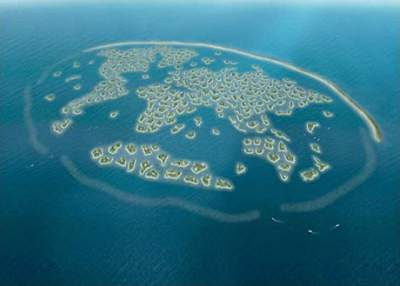
The World, one of Nakeel’s prestigious projects, will consist of between 250 to 300 smaller private artificial islands in the shape of a map of the world divided into four categories - private homes, estate homes, dream resorts, and community islands. Each island will range from 250,000 to 900,000 square feet in size, with 50 to 100 metres of water between each island.
The development is to cover an area of 9 kilometers in length and 6 kilometers in width, surrounded by an oval shaped breakwater. The only means of transportation between the islands will be by marine transport.
Many other celebrity couples are believed to have bought islands in this particular development, but the developer of “The World” Nakheel does not comment on who has bought islands within The World without the permission of the owners.
Celebrities are a key target market for Nakheel because they are assured perfect privacy as the plots are only accessible by boat, and security patrols surround the islands. The islands can also be developed to their own personal requirements.
Posted by PropertyMixer Admin at 3:27 PM 1 comments
Labels: Brad Pitt and Angelina Jolie, Nhakeel's "The World" project, private island in Dubai
Friday, November 30, 2007
A survey on real estate residential market of Twin cities - Hyderabad and Secunderabad

Hyderabad, the capital of Andhra Pradesh, has been known for its heritage, traditional hospitality and a thriving software industry. It is one of the largest metropolises of India, with a population of around 6.1 million people, spread over an area of approximately 625 sq.kms. The capital is in reality the twin cities of Hyderabad and Secunderabad linked together by the Hussain Sagar Lake and is now the second largest city in India with the recent inclusion of the 12 municipalities being merged into Greater Hyderabad.
This city that once predominantly depended on engineering based industries and trade as a means of income has seen a dramatic change over the last few decades. With the IT boom, companies like Microsoft, Oracle, Dell, Delloite, IBM, Perot, Polaris, Accenture, CA, HP, GE, UBS, Convergys and Franklin Templeton have set up offices in Hyderabad. This led to the development of infrastructure facilities and the general growth of the contiguous locations surrounding the Hitech City area, also referred to as Cyberabad, which has a coherence of its own due to the pace of development and the attraction of overseas investors. In recent times, owing to the interest generated in the Hitech City, real estate development has picket up considerably in the adjoining Gachibowli area where a number of campus development by IT major like Microsoft, Infosys, Wipro, Polaris, Kanbay, UBS, Franklin Templeton etc, are located. This has led to a substantial inflow of IT / ITES professionals, thus escalating the demand for Grade-A residential projects across Hyderabad. The research and survey done by professional real estate broker named M.L.Rao, chief coordinator of Equate Realtors (www.equaterealtors.com), having immense experience in real estate broking since 21 years at Twin Cities and having branch at Vizag.
Apart from the office market of this region, Hyderabad also as numerous prestigious educational institutions like Osmania University, ICFAI and Indian School of Business. The floating population of students from these universities has impacted the lifestyle and trends of the city as well. While a few years ago students stayed in hostels, nowadays they prefer to share apartment accommodations with batch mates.
Till a decade ago the mid-end residential development in Hyderabad were largely concentrated in locations like the Uppal Zone, Dilsukhnagar, Koti, Secunderabad, etc, while the localities of Banjara Hills, Jubilee Hills, and nearby areas continued to be premium locations. Market in these locations soon became saturated and due to non-availability of land parcels, builders were forced to move to other locations. Consequently, large scale developments are now seen in locations like Kukatpally, Madhapur, Miyapur, Madinaguda, Gachibowli, Nizampet, Kompally, Tellapur and Gopannapally.
Current Scenario
Infrastructure project like the Outer Ring Road (ORR) and the development of SEZs proposed by the government has led to speculation in the real estate market. This could be the cause for demand for land parcels and residential accommodations in Shamshabad, Maheshwaram and locations along Vijayawada highway. The housing requirement in the Madhapur-Gachibowli corridor has resulted in large scale Grade-A projects by major developers like L&T Info city, Lanco, Indu Group, IVRCL, Emaar-MGF, My home, IJM etc., ( Local builders like Manjeera Constructions, Alliance, Aparna etc). in the western and north western locations. The demand in Madhapur, Kukatpally, Jubilee Hills, Banjara Hills, Somajiguda, Yusufguda and Gachibowli as compared to other locations in primarily driven by the IT / ITES professionals with higher income levels enabling them to invest in these prime neighborhoods.
A notable trend in the buyer behavior of this city is the consistent demand for villas and row houses especially in the peripheral locations. This could be due to the buyer’s perception that the price of land will always be bullish. Buyers seem to be ready to commute 18-20 kms out of the city and invest in a villa. Of the total estimated supply for 2009-10, 25% will be in terms of villas and bungalows while 75% will be in the form of apartments.
Central Zone
The central zone includes locations such as Begumpet, Banjara Hills, Jubilee Hills, Somajiguda, Panjagutta, Chikkadpally, Ramkoti and Malakpet, most of which are in and around the Hussain
Sagar Lake. Majority of the locations form the traditional residential hubs of the city and capital values in this region range between Rs.2, 500-6,300. Since there are fewer land parcels available, most of the constructions encompassed in this region are stand-alone developments. Locations such as Banjara Hills and Jubilee Hills are still considered as prime residential locations and cater to the higher income segment. Construction activity in this micro-market is mainly observed on the inner roads of Banjara Hills Road No.10 and 12. However a large percentage of these projects are redevelopments of existing villas and bungalows. The projected supply to enter this zone by the year 2009-2010 is 1.61 mn.sq.ft. A few notable projects for this region would be Aditya’s Green Park with high-end apartments in the vicinity of Jubilee Hills on 6.91 acres of land, RRS Towers on Raj Bhavan Road and Prajay Riveria at Banjara Hills.
Northern Zone
Although a large percentage of the northern region is cantonment area, the project size in this micro-market is on a much larger scale than in most other locations of the city. This region has an even mix of both apartment as well as villa and bungalow development. This can be attributed to the fact that a considerable amount of the demand in these locations is investment driven. Maximum construction is being seen in Nizampet, Kompally, Bowenpally, Qutbullapur and Nagpur Highway and capital values for apartments and villas in these regions fall between the range of Rs.2,550-4,500 sq.ft. Many of the prominent developers have take up projects in this region as there are large expanses of land available complimented by excellent infrastructure facilities. Large projects in this zone include Ambience Neighbourhood by Ambience Group and Casa Estebana, a luxurious project by Koncept Ambience Group comprising 45 villas. A few other notable projects by local developers and Aditya’s Grand Ville of 100 independently villas and Ashoka’s ‘A la Maison’ in Kompally, Splendid Aparna Integrated township. This region is the second largest contributor to Hyderabad’s residential supply and has an estimated 9.13 mn.sq.ft. that is likely to enter the market by 2009-10.
Eastern Zone
The eastern zone comprises of locations such as Shameerpet, Yapral, Cherlapalle, Pocharam, Uppal, Kuntlur, Musheerabad, Marredpally and parts of Secunderabad, and has an estimated supply of around 2.46 mn.sq.ft that would enter the market by 2009-10. This region mainly consists of gated community and villa development, as buyers prefer to take a villa rather than an apartment at the prevailing rates. The northern part of this region has a majority of projects in Shameerpet and Yapral. Two large projects in this micro-market include those by Prajay Engineers Syndicate Ltd called Prajay Celebrity Villas and Prajay Bloomingdale. While the northern half of this zone is experiencing active real estate development in the above locations, the rest of the eastern zone is witnessing activity concentrated at Pocharam on Warangal highway. A notable construction in Whitefield is that by Hallmark Construction called Express Towers which has an amphitheatre among the facilities being offered. This zone is both end-user as well as investment driven, the capital values ranging between Rs.1, 600-3,500 /sqft.
Western Zone
The western part of the city encompasses locations in Cyberabad such as BHEL, Madhapur, Gachibowli, Gopannapally, Kukatpally, Miyapur, Nanakramguda, Manikonda, Bachupally, Kondapur, etc. this region with a supply of approximately 39.72 mn.sq.ft. is the major contributor to the overall supply that is likely to enter the Hyderabad residential market by 2009-10. North western regions like Bachupally, Borampet and the locations around the Biotech Park mostly have villa and row house development, while Madhapur, Gachibowli and Kukatpally, and have high-end residential apartments which are 5-14 stories high. L&T Serene County in Gachibowli, spread over 31 acres, includes a shopping complex and community centre.
Other notable projects in these locations include Hill Ridge in Gachibowli and Lanco Hills in Manikonda. Raintree Park, a joint venture township project between Andhra Pradesh Housing Board and IJM (India) Infrastructure Limited, is being developed at Kukatpally on 35 acres. Locations like Nadagandla, Gopannapally, and Hitech City have a preponderance of demand for apartments as compared to the rest of the western region. The demand is end user driven with a majority of the supply being taken up by those working in Hitech City and the neighboring commercial hubs. Development of gated community or bungalow schemes is on a rise in this region as it provides support infrastructure for the same. Some of the prominent constructions in these locations include Silicon County at Madhapur by the Jayabheri Group, Prajay Ridge Wood at Nadagandla and Maytas Hill County at Bachupally which has a business centre amongst other facilities. Most of the development in these locations are Grade-A and capital values for apartments and villas are within the range of Rs.2, 400-4,750 / sq.ft. with a demand for mostly 3 BHK apartments.
Southern Zone
The southern Zone comprises locations such as Himayatnagar in the south east and Shamshabad, Maheshwaram, Karmanghat etc. in the south. The south does not have much construction taking place with developers taking up most of the land parcels and dividing them into smaller plot layouts for sale. The ORR and the new international airport have been the key demand drivers for real estate activity in these locations. Around 3.38 mn.sq.ft. Of residential supply is under construction in the south and southwestern region. Most construction activity, however, is still in the nascent stage with the exception of a few projects like Banyan Tree Retreat by MAK Projects and Aliens Space Station II by Aliens Developers. These locations still cater to the middle-income group and till the development of Fab City along with other proposed project this trend would be unlikely to change. The capital values for apartments and villas in this zone range between Rs.1, 700-4,372 / sq.ft.
Outlook
The Hyderabad market is likely to witness considerable real estate development over the next few years with the construction of the new Outer Ring Road which would connect all the national and state highways. Locations on either side of the ORR shall witness considerable development. In addition to the proposed radial roads, the government has approved a proposal to set up a Hyderabad Knowledge Corridor consisting of IT and ITES companies covering over 20,000 acres in Ranga Reddy district. Industry experts are sceptic about availability of large land parcels with clear title for construction of gated layouts or integrated apartment complexes. Another cause for concern among developers has been the introduction of Government Order (G.O.) 86 which has laid down certain strict guidelines for building activity in city central areas. However the advantage of G.O.86 is that in the peripheral locations of the city, there is greater scope for bigger project to come up. Recently, the increase in home loan interest rates has resulted in prices stabilizing and in some locations even reducing marginally. There has been a reduction in the number of home loans that have been taken after March 2007 due to the rise in interest rates and this could lead to a drop in demand in the immediate future. Currently the average ticket size for home loans in Hyderabad is around Rs.2 million. This market resistance is causing quite a few builders to postpone public openings of booking for new projects. Greater Hyderabad however is likely to emerge as a financial hub in the near future.
Contributed By : M.L.Rao
Posted by PropertyMixer Admin at 11:53 AM 3 comments
Labels: Hyderabad, Hyderabad Real Estate Growth, Real Estate In Hyderabad, Secunderabad, Tiwn Cities
Sunday, November 18, 2007
A Glimpse of NASHIK – Arising as a prospective Real Estate Destination
Location: On The Banks of the River Godavari, Maharashtra

'Nasik' also known as 'Nashik' is the third largest Municipal Corporation in Maharashtra, with approximately 25 percent area under residential zone. Nashik is popularly called as the 'Wine Capital of India', owing to its abundant grape crop. However, the city has already been undergoing industrialization for the past decade after Mumbai, Pune & Nagpur and is seen as the next most sought-after commercial destination of Maharashtra. Nashik falls midway between the industrial hotspots of Mumbai and Mumbai and owing to Nashik’s civilized environs and skilled workforce, it is turning out to be the IT & ITES Sector’s next preferred destination. Though still in its nascent stage, Nashik’s IT / ITES Industry growth is poised to grow multi-fold by 2009.
The authorities, on their part, are propping the city with improved transport and civic infrastructure to meet the challenges that a culture shift would bring about. Over Rs. 11,000 crore has been invested toward improvements in Nashik infrastructure since 2005, and after the makeover plans envisaged for the city by the Jawaharlal Nehru National Urban Renewal Mission (JNNURM), the city is in for a property boom.
Once projects like the four-laning of the Mumbai-Nashik highway and the upgradation of the Nashik airport are complete, the Mumbai-Pune-Nashik Golden Triangle will generate high levels of employment. With land rates in Nashik still at three digits in some neighborhoods, Nashik is a great investment destination and is bound to give the benefits to the investor specially since a lot of SEZs are coming in the area.
Indiabulls Real Estate in its news release has announced that its wholly-owned subsidiary company, the Indiabulls Infrastructure Ltd. has got the Formal Approval for the development of a multi-product SEZ in Nashik, Maharastra. Department of Commerce (SEZ Section), Minis of Commerce & Industry, Government of India approved the proposal.
Corporates & Developers like Raheja, Reliance, Tatas & India Bulls are bullish on Nashik and its growing 360 degrees including residential, commercial & retail and its definitely one choice worth investigating for the investors. Even one of the latest FICCI-Ernst & Young report also mentions Nashik along with a few others as a prospective investment destination in India.
Contributed By : Abhi Chopra
Posted by PropertyMixer Admin at 11:18 PM 3 comments
Labels: Nashik, Nashik Properties, Nashik Real Estate, Nasik, Real Estate growth in Nashik
Sunday, November 11, 2007
Kolkata’s real estate market is set for a high growth phase fuelled by the IT/ITES sector
“Kolkata boasts of a highly literate and well equipped workforce, lower land acquisition costs (when compared to Mumbai and Delhi) and attractive government initiatives which make it a compelling destination for corporates and developers, alike”, said Mr Vincent Lottefier, Country Head, Jones Lang LaSalle India. He further added, “We at Jones Lang LaSalle are excited to be a part of Kolkata’s growth and pleased to offer our entire range services including transaction management services, retail advisory, strategic consulting, capital markets, property management, integrated facility management and project and development services. The report states that increasing corporate presence is stimulating growth in per capita income and encouraging consumption in Kolkata. Overall, the city provides a positive environment for new corporate entrants, as well as existing corporates eying expansion.
Abhishek Kiran Gupta, Senior Manager, Research, Jones Lang LaSalle, India adds “Kolkata is now on the ‘global radar’ of multi-national companies – a large skilled labour pool, a pragmatic, business-friendly and stable business environment, active promotion and incentives, combined with low operating costs and the city’s strong cultural heritage are attracting the attention of both the domestic and international business community. The city has become a favoured destination for IT/ITES activities, with a rapidly growing corporate presence.
Kolkata now has most of the ingredients in place to move its economy up the value-chain – its size, skill base and heritage point to a significantly higher international profile over the long term”.
According to the report, Kolkata, whose economy grew by 8% in 2005, is home to 175 IT and ITES firms which employ approximately 40,000 people. Rapid expansion and increased business activity is expected to strongly boost demand for speculative built space as well as built-to-suit offices and 4.5 million sq ft of additional supply is likely to be completed by 2007 in Salt Lake and New Town Rajarhat. The city is also a high priority destination for domestic and international retailers with over 2-3 million sq ft of organized retail under construction by 2008.
Stimulated by the growth of the IT/ITES sector, hotel room demand in Kolkata is expected to grow at an annual 11.7% over the next five years and supply at 15.4% per year. Similarly, Kolkata’s residential demand continues to be strong, as shown by absorption patterns of recent residential demand, which are expected to grow in tandem with economic activity and investor interest.
“Emerging City Winners” is Phase IV of the Jones Lang LaSalle’s World Winning Cities Research, a multi-year programme which draws together the essence of contemporary city competitiveness. World Winning Cities Research examines trends that impact the business and economic landscape, and how these factors are coalescing to create the rising urban stars of the next decade. The research aims to identify the winners and losers among the emerging BRIC cities in India, China, Russia and Brazil.
Posted by PropertyMixer Admin at 10:55 PM 0 comments
Labels: Construction Investment in Kolkata, Emerging City Winners, Jones Lang LaSalle, Kolkata Real Estate
Thursday, November 8, 2007
Vastu Shastra – An introduction
Vastu Shastra, which was earlier considered as a archaic or a primitive science and was also regarded as a Luxury for the Wealthy few had now exploded and metamorphosed as mainstream thought, whereby most of the buyers of property as well as construction companies consider it extremely important to get the property assessed by a Experienced VASTU Professional in order to asses the strengths and weakness of the plot and also to get to know what energy the property can render to them in the long run.
But the Doubts still remain, As what do u really mean by Vastu and How can it Help us lead a Life of contentment and bliss?
Bhrama Created the world and then appointed Vishwakarma to device a system of Planning and Architecture Thus was the beginning of Vastu Shastra. Vastu Shastra Literally means the science of architecture but its is much more than architecture it also takes into account various other factors like Water, Plantation, Shape, Size, color, Directions and Numerology.
Vastu Shastra As mentioned is an Environmental science works by balancing your environment in accordance with the natural laws inherent in the universe Vastu takes into account not only architecture but also several other aspects, such as numerology. What leads to peace and harmony, which naturally are conductive to health and prosperity and its Possibilities are limitless.
This science if followed properly gives definite and positive results to its occupants. The place may be of any type Residence, factory, Shop, restaurant or even a Temple, if the Rules are properly Followed the Results are assured to be positive and there will always be happiness and Prosperity.
VASTU FOR BUILDING CONTRACTORS
Since My First Article, which appeared in this Esteemed, magazine Last Month I Have received a fabulous response from Builders and Numerous Queries from Reputed Building Contractors mainly asking me As to How Vastu Can be used effectively for their Construction Activities, As More often their Projects are already Designed and they merely have to carry out the construction as per the schedule without any changes.
Based on the Above Queries I am writing the Following Article explaining a few points As to how Vastu Can be effectively used and very well followed (in a Limited manner) to generate positive Energy and Better Results.
- Date of Construction: Date of the Start of Construction is very Important for Any Construction activity to Begin. Auspicious Dates Bring out Better Results. –
Some of the Few Considerations are Given Below - The Nakshatras Rohini, Mrigshira, Chitra, Hast, Swati, Anuradha, Uttarashdah, Uttar Bhadrapad, Uttar Falguni, Dhanshtha, Shatbhisha, Revati are good for starting the house construction work.
- Days - Monday, Wednesday, Thursday and Friday are good days to start construction work. Sunday or Tuesday should be avoided.
- Construction started in Shukla Paksha brings happiness, while that in Krishna Paksha is not considered too auspicious
- Clearing & Leveling of the Land: Clearing of the Land of Thorny plants / dead trees and Rocks in necessary before any construction activity to start (Especially in the North-East). Also Leveling of the piece of Land (Which I am Sure is in the hands of the contractors) Plays a Very Important Role in Vastu Shastra. Proper Leveling with certain portion of the Land bit higher than the Other Creates a very Good flow of cosmic energy thus ensuring uninterrupted construction activity and proper flow of finance.
- Shanku Sthapana (Vastu Pooja): SHANKU means Energy Converter And Shan
ku Stapna is the Pooja Done for Laying the Foundation Stone and praying to the SHANKU ,which Plays a Very Important Role to remove the Negative radiation/Energy from the Piece of land . Different people Use Different Shankus or (Energy Converters). Pooja is offered to this Shanku and Then its Buried in the Exact Mid-point of the Plot, As it is Believed that any form of Energy Moves towards the Center /Midpoint of the Plot and Having a Shanku Buried there Will ensure suppressing the negative energy thus Avoiding any Harm to the Construction Activity.
- Starting Point of Construction: As per the Principles of Vastu-Shastra, The Starting point of Construction is Very crucial. Construction is Generally Beneficial when Started from The South-East Portion and Moved in a Clockwise Manner. This will ensure smooth construction activities.
- “ For Construction Companies in the business of construction of Roads and Bridges, they Should Always Follow the Principle of Starting from a Negative location or Energy point and Moving towards a positive Location or Energy point. This automatically pushes the Project faster with uninterrupted flow of finance.” Secondly Proper Leveling of the Roads and Bridges as per Vastu will definitely bring prosperity to Construction companies who work on the arrangement of B.O.T (Build, Operate, Transfer).
- Placement Of the Contractors Office: Every Contractor builds a Temp
orary Site office at the Construction Site. Proper Placement of this Office at the Site, Including sitting arrangements of the Contractor / managers etc facing the Best Directions enhances the energy level of the persons working on the project. This helps in getting better results from the staff and managers working on the Project
- Placement of Machine
ry / Construction Material: Proper Placement of the Machinery and Construction Material is also very crucial to generate positive energy and ensures favorable movement of the project. Electric Machinery will give positive Results when placed in the Agni Sthan. Other materials like Sand and Bricks Should be Placed on the Prithvi Sthan or The South. Placement of Temporary Water tanks for Construction is of Utmost Important as Water is a powerful form of ENERGY. They should at no cost be placed in the South –West. This will definitely cripple the Project and will bring losses to the Developer.
Posted by PropertyMixer Admin at 11:59 AM 1 comments
Labels: VASTU FOR BUILDING CONTRACTORS, VASTU Professional, Vastu Shastra